How to draft your Resume?
Princepal Rajput
9/2/20243 min read
Before I discuss Resume in detail, please note that the component of Resume plays a vital role in Masters application. For Bachelors application, it is not that important.
What is a Resume? It is a document that summarizes your academic qualifications, your corporate or social work experience, projects, skills, etc. It is used for job or university applications.
There are three factors you should be mindful of when you draft your Resume. They are: formatting, structure, and impact statements. Please allow me to discuss them below.
Formatting:
1. The preferred file type for your Resume is pdf.
2. Use black text and keep the font and size clean, simple, and consistent.
Nothing further on formatting. However, both the points are non-negotiable.
Structure:
Have a look at the Resume below. You would see that there are seven sections entitled in capital letters in bold. They are education, experience, skills, etc. Before you decide what sections would you like to put on your Resume summarize your education, experience, skills, and competencies and think about the requirement you are submitting your Resume for. Now, exclude the details that are irrelevant to your application.
The length of your Resume should not exceed one page. Even if you are a mid-career professional, it’s recommended to have a one-page Resume. To understand why am I stressing on the one-page aspect think about it this way. Admissions committees get thousands of applications and if you give them an unnecessarily long Resume it’s likely that they would not scroll through the multiple pages. But, if you give them something nicely packaged and thoughtfully put together, they would give it a second glance, see through details and they would be prone to be more impressionable.
Here I have a sample Resume of a student who passed out recently and is in early career stage which is why the education is first in order.
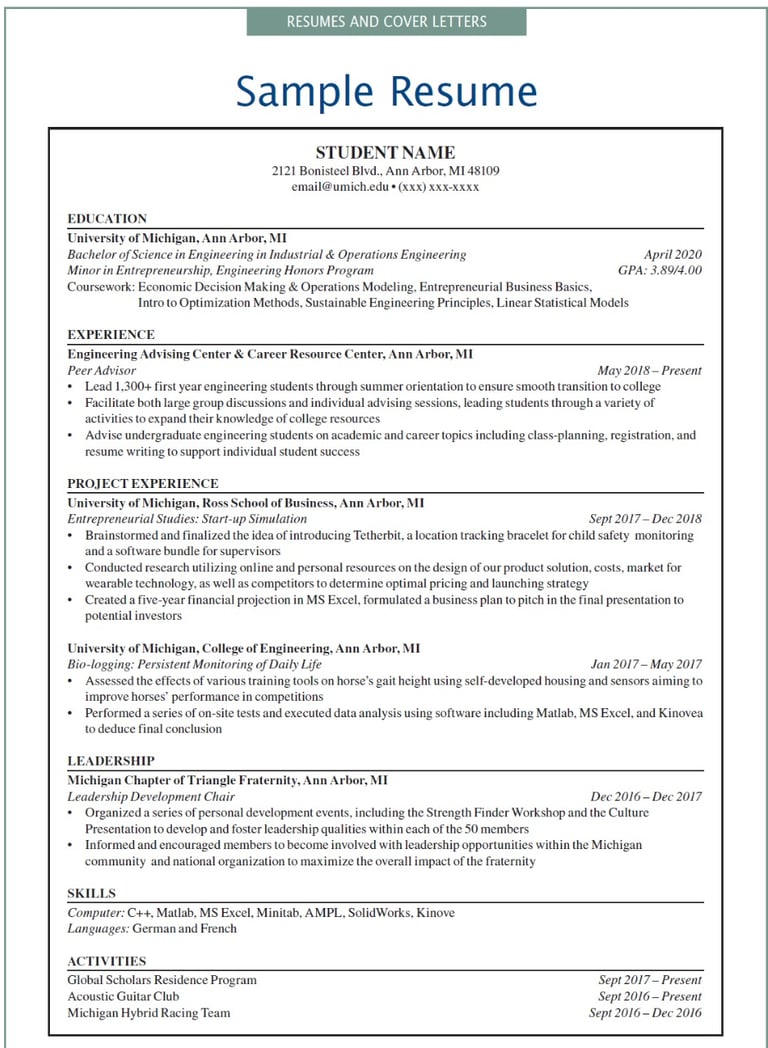
Note: Organize things in the way university or recruiters are used to seeing them.
Put education before experience if you're a student or a relatively recent graduate.
Put experience before education if you've been in the workforce for more than a position or two.
Impact statements:
For the bullet points/impact statements under work-ex, projects, etc. you must follow the XYZ formula. Please find below more on the formula.
1. X describes what you accomplished.
2. Y is for how you measure what you accomplished.
3. Z describes the how of your result. It gives us a context. Define skills, tools, programs, etc.
To illustrate the formula please have a look at the impact statement below.
Grew revenue for 15 small and medium business clients by 10% QoQ by mapping new software features as solutions to their business goals.
Let's dissect the above statement. X is "Grew revenue." Y is "15 small and medium business clients by 10% QoQ." Z is "by mapping new software features as solutions to their business goals."
Tips:
Include your contact details on top of the page, aligned centrally.
Title the sections on your Resume as: Education, Experience, Project Experience, Skills, and Other Pursuits.
Use reverse chronology for all the sections. For education, superimpose your Masters over your Bachelors. For experience, start with your current job and so on.
Don't forget to include links to your profile on industry-specific forums. For instance, the link to your Github profile if you are a programmer, the link to your Behance profile if you in the digital creative industry, etc.
Don't include photos or graphics. Exception for this rule would be for professionals/students in creative industry. Architects, UI/UX designers could include photos, designs, etc.
Please feel free to contact me for any questions you may have. I assist students/professionals in putting their best on their Resume.